


About
About Katch Data
Founded in 2019, Katch Data was developed by leaders at the intersection of data science, technology and entertainment. In 2019, Andrew Tight (film producer at Lionsgate), Dr. Nolan Gasser (architect of the Pandora Radio Genome Project and author of Why You Like It: The Science of Culture ...
Links
Contact
Authenticity at Scale: Katch’s Content Genome Predicts What Media Will Connect Best
When Andrew Tight, a producer at LionsGate, heard about how the company planned to promote one of his films, he was confused. It was a movie made for 4-6 year olds, and it was being advertised at the Rose Bowl. “I didn’t understand the logic behind that move,” he recalls. “I asked and was told that there were a lot of eyeballs there. That was true, of course, but this made me wonder if there was a different way to identify who would like a film. I got obsessed with why people like what they like and how we can determine if a person will love a movie or show.”
This experience sparked a multiyear journey that led to Katch, a service that has created the first content genome for audio-visual works from feature-length films to TV to books and other media. The company has become a secret weapon for Hollywood and is now bringing its unique, road-tested approach to branded content.
The original spark inspired Tight, who had ten profitable films under his belt, to look at who was consistently surfacing stuff people liked. He landed on TikTok and Pandora, which made him dive deeper into genomic approaches to content. He crossed paths with Dr. Nolan Gasser, a trained musicologist who was one of the driving forces behind Pandora’s Music Genome Project and a pioneer in classifying (and thus suggesting) content. Together, Tight and Gasser decided to develop a new generation Media Genome that could capture the full content of film and TV; this new genome would surface what to watch, for example, when two friends with partially overlapping tastes decided to watch a movie together.
To accomplish this, Tight, Gasser, and the Katch team spent four years working with a crew of film students to watch and code movies, shows, and other content, accumulating millions of data points regarding characters, context, plot, cinematography, dialogue, mood, and many other parameters. “You have to capture everything that makes that content tick, whatever gets at the identity and the experience of the title,” explains Gasser. “When we code a show, game, or book, we have to cover every dimension or parameter, capturing its entire being. Large-scale parameters are distilled into quantifiable, very granular factors, such as the context, setting, time, reality, environments, characters, relationships, interactions, editing, cinematography, emotions. How they combine to impact the audience, that overall aesthetic experience.”
This structured approach to capturing aesthetics and vibes, the basis for Katch’s B2B product for the entertainment industry, has informed more automated, ongoing ways to code short-form content on social media platforms. While each format and medium has its nuances, Katch's expanding genome — now capturing content in film, TV, books, games, music, social media content, as well as consumer products — ensures uniformity across them, creating a powerful basis for evaluating and analyzing content at scale. “We’re not just throwing an LLM at a general process. We have spent the past few years refining how we code TV, music, films, books, and shortform video without violating copyright,” notes Chief Product Officer Allie Shaffer. “We have a complex pipeline with very specific information for each medium, while the genome makes sure each part of the system speaks to each other.”
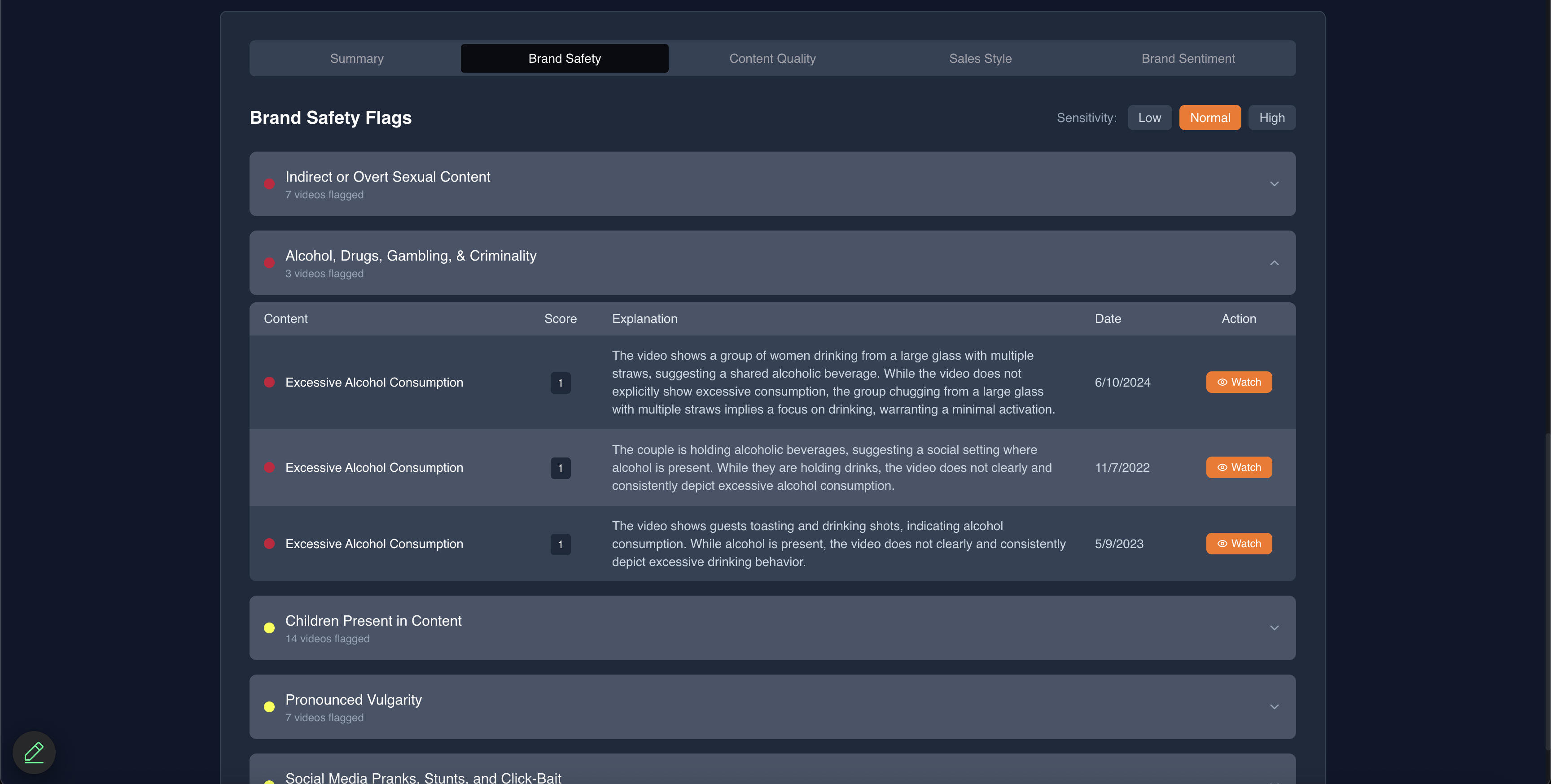
From its origins in serving entertainment creatives and executives, Katch has expanded the offerings built on its proprietary structured data and content genome to social media assets and short-form video, reimagining everything from brand safety to influencer marketing in the process. Thanks to the interplay of genome and medium-specific intelligence engines, Katch now allows its customers to predict content performance, not simply react or try to replicate what worked for some mysterious reason. “Studios, creators, and brands are flying blind,” notes Tight. “They can generate content quickly thanks to AI. They can analyze what happened with that content. But they can’t get a clear, data-informed idea of what might really engage the people they want to reach.”
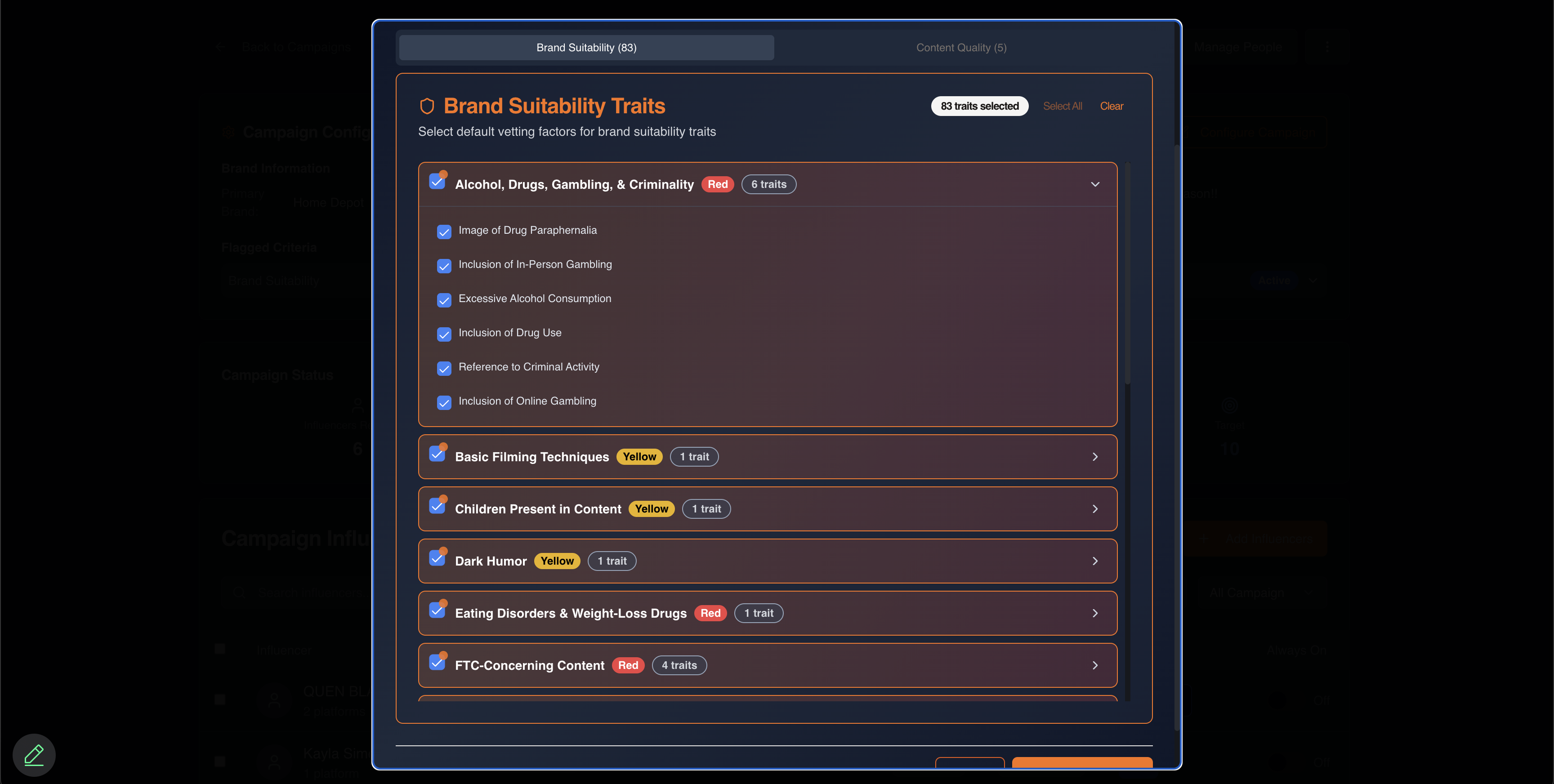
Thanks to this content evaluation system, Katch can vet influencers in a flash via its new Katch Verified platform, ensuring that brands can work with influencers with complete confidence that the fit is perfect and safe. And coming soon, Katch’s Creator Playbook will make it remarkably straightforward to not only evaluate engagement, but to predict content performance and make brand content better. When it launches early next year, the Creator Playbook will guide brands start-to-finish through the content process, from analyzing past online performance to predicting what will work best to helping create the right content using AI.
These products all serve a similar purpose: to home in on true authenticity in campaigns and content. “At a recent ad industry conference, the word I heard those around me use the most was ‘authenticity.’ How do you make sure your content feels authentic?” Tight says. “We want to free brands up to focus on that question. With Katch, they don’t need to think twice about safety, and they can be a lot more intentional about what is right for the brand.”
Safety and authenticity can benefit more than brands; Katch hopes its approach will eventually change the social media landscape for everyone. Katch is already working with certain social platforms to improve suggestions and moderation, and it’s looking toward a future when we port our taste across the internet, regardless of what site or platform we find ourselves on.
“We have a bigger vision,” Shaffer states. “When Katch is plugged into more platforms, users will be able take advantage of a data-supported taste passport. When users say with data, ‘this is who I am, this is what I want,’ it puts power back into the hands of the individual.”
About Katch
Founded in 2019, Katch was developed by leaders at the intersection of data science, technology and entertainment. In 2019, Andrew Tight (film producer at Lionsgate), Dr. Nolan Gasser (architect of the Pandora Radio Genome Project and author of Why You Like It: The Science of Culture of Musical Taste), Kyle Haley (engineering at Disney) and Jacob Clifton (Data Science and Artificial Intelligence at the Massachusetts Institute of Technology, NBCUniversal, Warner Brothers and Ticketmaster) teamed up to create Katch. Katch quickly gained traction within the entertainment industry and began working with clients including Warner Bros. and Paramount.